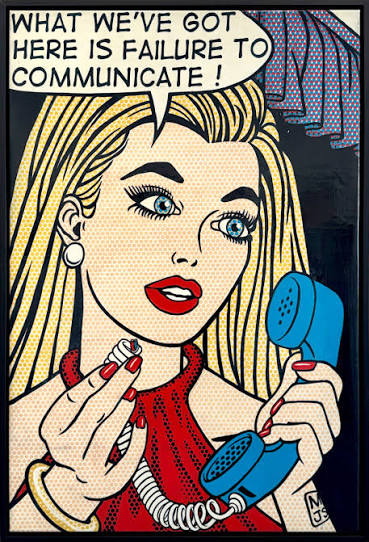
How important is communication in leadership?
And before you answer, I’m talking about communication among leaders. We spend a lot of time discussing how we communicate with our teams. But what about the people leading alongside us?
When I worked in corporate, I reported to a manager who also had other coaches reporting to them.
That was my team, too.
My manager expected us to communicate and work together. If we were going to be successful, we were going to do it together.
Sounds familiar, right?
But that wasn’t always how it worked. And when communication broke down among the leaders, it didn’t stay among the leaders.
People start picking sides
On the last leadership team I was part of, I experienced confusion, assumptions, hurt feelings, and stress when communication wasn’t working.
What stood out to me was the division.
It started to feel like Leader A versus Leader B. Employees picked sides. There was chatter among the teams, and the tension between leaders became something other people were carrying.
That’s a difficult environment to work in.
It also makes me ask: What are we showing our employees when we expect teamwork from them, but struggle to practice it ourselves?
We can tell people we’re one team. But they also see how we treat one another, how we share information, and what happens when we disagree.
They notice.
Different field, familiar lesson
Many of you know that I started over in a new field as a REALTOR. My leadership experience came with me, and so did my belief in communication.
That includes communicating with other REALTORS.
Gary and I recently picked up an open house for another listing agent. We like to prepare ahead of time so we can walk in ready to answer questions and focus on the people visiting.
This time, getting information was difficult.
We didn’t have the disclosure documents we wanted available to help answer questions about the home. We kept asking for them almost up to the day of the open house.
We had also requested a three-hour open house, which is what we usually do. It was entered for two hours instead. The home was vacant, and we wanted to understand the reason for the different schedule, but we weren’t getting a response.
There may have been a reason for the two-hour window. Without an answer, we couldn’t understand it or plan around it confidently.
The open house itself went smoothly. Getting there was stressful.
Those two things can both be true.
The result doesn’t tell the whole story
It would be easy to say, “Well, the open house went fine. What’s the problem?”
The problem is the extra effort it took to prepare without information we were trying to get.
A successful outcome doesn’t automatically mean the way we worked together was effective.
I also want to be fair. I know what we asked for, what responses we were waiting on, and how that affected us. I don’t know everything that was happening on the agent’s side.
That experience was different from the division I saw in corporate. But it brought me back to the same question: How do we set one another up to do our work well?
For me, communication means sharing information and making sure we understand each other. That includes knowing what’s needed, who is handling it, and when we can expect an answer.
Sometimes the answer might simply be, “I don’t have that yet. I’ll update you tomorrow.”
At least then we know where things stand.
“Can we talk?”
Someone has to start the conversation.
And that can be the hard part.
A simple “Can we talk?” with another leader gives us a place to begin. Then we have to explain what isn’t working without assuming we already know why.
On a leadership team, that could sound like:
“Can we talk about how we communicate with each other? I want our teams to see that we’re working together, too.”
Then we need to get specific. What information isn’t being shared? Where are expectations different? What are our teams hearing from us?
We also need to listen to the answer.
If I start a conversation about improving communication, I have to be willing to hear that something I’m doing needs to change.
That’s part of the work.
Here’s my part
Gary and I didn’t discuss the communication difficulty with the agent afterward.
We asked for what we needed before the open house. But we didn’t follow up with a conversation about how the preparation had gone.
So I can’t write this as though I handled every part perfectly.
That’s a step I can take differently next time.
“Can we talk about how we prepared for the open house? We were still trying to get information close to the date, and I’d like to agree on what we’ll need and when for the next one.”
That gives us something to work through together. It also creates room for the other person to explain what would help them.
The goal is a clearer plan for working together.
We belong to a team, too
Leaders are allowed to disagree. We bring different experiences, priorities, and ways of working.
But those differences need a place to be discussed. When we leave them unresolved, our teams can end up filling in the blanks, making assumptions, and taking sides.
I want the people I lead to know they can work with other teams without feeling like they’re choosing between leaders.
That starts with what they see from us.
So here’s my question: Have you ever worked on a team where tension between leaders started dividing the employees? What helped bring people back together?
And if there’s a conversation you’ve been putting off, what would it take to start with, “Can we talk?”
I have to ask myself that question, too.
But hey, you do you.


Leave a Reply